The route for the 2027 Tour de France and Tour de France Femmes route were announced on Thursday, and fans and commentators, Cycling News included, have spent the last 36 hours dissecting the stages and analysing what it all might mean next summer.
From the abundance of TT kilometres and how they might help Remco Evenepoel, to the lack of big mountains in the women’s race, there’s been a lot to talk about and speculate on as we try to imagine what the race will look like and how it compares to recent years.
But how about a more scientific approach? The Tour de France route reveals can be a bit of an info dump of numbers – this many total kilometres, that many metres of elevation gain – and the raw numbers can tell us something, but not everything.
So to try and understand what all those facts and figures actually mean, and how they compare to the last decade or so of the race, we put our data-crunching hat on to process some of the key figures, and visualise what it all means.
-
sale
Cube Kathmandu Hybrid C:62 SLT 400X Easy Entry 2026 – Electric Hybrid Bike
£4,999.00Original price was: £4,999.00.£3,999.00Current price is: £3,999.00.

From the women’s race featuring the lowest high point since 2022, to a remarkably low amount of summit finishes in the men’s race, crunching the numbers threw up some really interesting results. So here are all the key stats about both of next summer’s Tours de France.
Tour de France Hommes
One of the headline stories of the men’s route reveal is that the 21-day race will feature the most individual time trial kilometres we’ve seen since 2012, when Bradley Wiggins took the victory on a course that features just over 100km against the clock.
The following year also featured 90km of TTing, though 25 of that was in the team time trial discipline, but since then the amount of kilometres against the clock has been trending somewhat down, hitting a low in 2023 with a mere 22km of TTing.
This year was nearly as low, with just one 26km effort against the clock, but the organisers have done a 180-degree turn for 2027, upping the total to 71km across two 30+ kilometre TTs.
See more: Could 71km of time trialing actually help Remco Evenepoel win the Tour de France? A closer look at exactly what the Belgian could gain against Pogačar
Whilst the amount of TT kilometres in the Tour have fluctuated fairly wildly over the last 15 years, there are some things that have stayed remarkably consistent.
The total length, for example, has varied by less than 200km over the last decade, with the organisers settling on a reasonable total distance of around 3,400km for the modern era – a far-cry from the 5,000km+ of the early Tours.
So instead of looking at the raw length of the race to determine difficulty, then, we have to pick out some different stats to determine just how hard the 2027 Tour
As with any excercise in statistics, you can get a different answer depending on what set of numbers you look at.
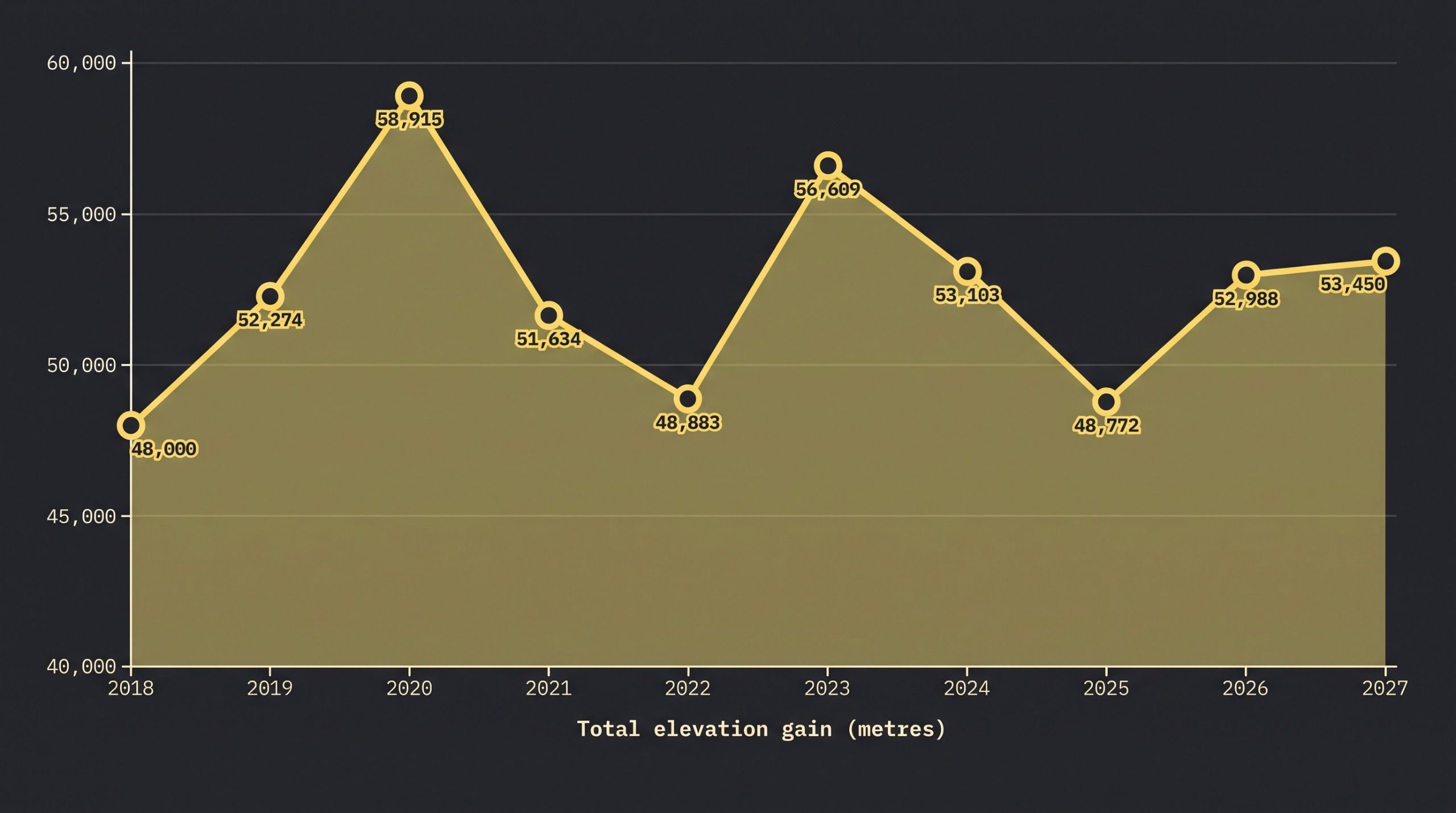
Take the total elevation gain, for example. The 2027 Tour de France will feature a total of 53,450m of climbing over the three weeks, which is slight increase on this year's tally, and quite a jump up from the figure for 2025.
Its by no means an outlier for the decade, with previous editions featuring almost 59,000m of climbing, but it's an upwards trend when looking at the last four editions, and certainly makes it sound like a climb-packed route.
More climbing than the last three editions, so it's got to be harder, right? Well, not necessarily.
Whilst the grand total of vertical metres is higher in 2027 than we've seen recently, it's the way that climbing is spread out and accounted for which is interesting. The 2027 route has packed in more climbing overall, but it's more evenly spread across the three weeks rather than on certain ultra-tough stages, and it largely doesn't come in the form of big climbs, as the next graph shows, but rather
Some recent editions of the Tour have seen the peloton tackle 10 climbs that peak out over 1,750m altitude, so just two this year – the Col du Tourmalet and Col du Portet, both coming on stage 18 – feels remarkably low. The peloton will only face high altitude on one singular day next July.
It's a similar story in terms of summit finishes, with just three of the 21 stages featuring a true summit finish – stage 9 to the Grand Colombier, stage 11 to Les Saisies, and stage 18 finishing atop the Col du Portet.
A few editions of the last decade have seen a number that low, but in the Pogačar era, we have generally been used to five or six summit finishes, even as high as seven if you go back a few years.
So most of the real difficulty of next year's Tour de France route comes on stage 18 with it's double helping of 2,000m+ climbs, but even the Queen stage is something of a downgrade on recent years.
Packing in 5,400m of climbing, it's by no means anything less than an epic stage, and features more elevation gain than the hardest stages of many of the last 10 editions, but it is fewer than the hardest stages from 2025 and 2026.
2025's Queen stage to the Col de la Loze and 2026's to Alpe d'Huez both featured over 5,600m of climbing and, actually, were not the decisive GC stages. Perhaps ASO felt that more hasn't always equalled more, and those gargantuan numbers weren't needed this year, but it's interesting to note nonetheless.
Tour de France Femmes
Whilst it takes a little bit of digging to work out how the 2027 men's route compares to previous years, the discrepancies between next year's women's race and editions gone by were a bit clearer to see when the route was unveiled on Thursday.
For the first time since the inaugural edition in 2022, the women's Tour isn't visiting either the Pyrenees or Alps, focusing on the Massif Central instead. By heading to the third-biggest mountain range in France, the organisers are of course limited in the size of climbs and mountains they can include, and the race is missing one big mountain – the Puy de Dôme is the headliner – but actually, the dip in difficulty isn't as much as you might imagine.
The 2027 edition features fewer metres of elevation gain than 2026, yes, but more than every other edition, including the ones that visited the Col du Tourmalet and Alpe d'Huez, with an extra stage and more climbs per stage really packing in the total elevation gain.
Perhaps the most striking stat of all, then, is how the highest point and biggest climb of next year's Tour de France Femmes compares to the last five editions. Hint: not well.
With visits to the Alps, Pyrenees and Mont Ventoux, we've routinely seen the women's race climb over 1,900m and some truly high mountains, but this year, the race won't even clear 1,500m.
The highest point of the race will come on stage 8 with the Col de la Croix Saint-Robert peaking out at 1,451m, just a little higher than the climactic Puy de Dôme summit finish on stage 9 (1,415m). The Col de la Croix Saint-Robert comes mid-stage, rather than being a summit finish.
Whilst that's one way to look at it – and it is a shame to see the lowest mountains since this race began – it doesn't necessarily mean that the climbing stages are 'easier', just because the individual climbs may be.
When you combine everything together, stage 9 of next year's Tour de France Femmes will actually have the most total elevation gain of any stage since the race began, with 3,840m of climbing beating the previous record that stage 8 to Alpe d'Huez set in 2024.
Whilst ASO only have the sub-1,500m climbs of the Massif Central to play with, they've packed a whopping seven climbs in the run-in to the Puy de Dôme on stage 9, which will undoubtedly make the 11km climb feel a lot longer and harder than it is.
So just because no single climb breaks the 1,500m doesn't mean the climbing is any less – it's just going to be spread out in a different way across the Queen stage.
In terms of overall distance, the women's race has stayed very consistent since it upped its length from eight stages to nine in 2025, and the average stage length of around 130km feels about right, with most editions throwing in a 160km+ stage, too.
Finally, the TT question. With only five previous editions to compare to, two of which featured no time trialling of any kind, there isn't too much statistically analysis we can do on the TTing kilometres in the women's race.
In truth, it seems like the race organisers really can't settle on what they want to do about the discipline. Include a real challenge against the clock, as they did in 2023 and 2026? Squeeze in what is essentially a prologue? Or skip it all together?
Well, in 2027, they're doing none of those things, and trying out something new entirely: a team time trial around London on stage 3. It will be a novel event for the women's race, and ticks the box to give the riders some time on a TT bike, but it's a different ask from an ITT, and will certainly yield very different results.
If the Tour de France Femmes wants to be a Grand Tour, that means a rounded, balanced route, which should almost certainly always include an ITT. They can play around with the format and length, as we've seen the men's race do, but zero TT kilometres would never fly for the men's race, and it probably shouldn't for the women, either.
The road season might be at an end, but Cycling News isn't slowing down. Subscribe for unlimited access to our comprehensive news coverage, industry-leading CN Labs testing, expert columnists, and so much more. Plus, the Cycling News app means you can stay up-to-date wherever you go!