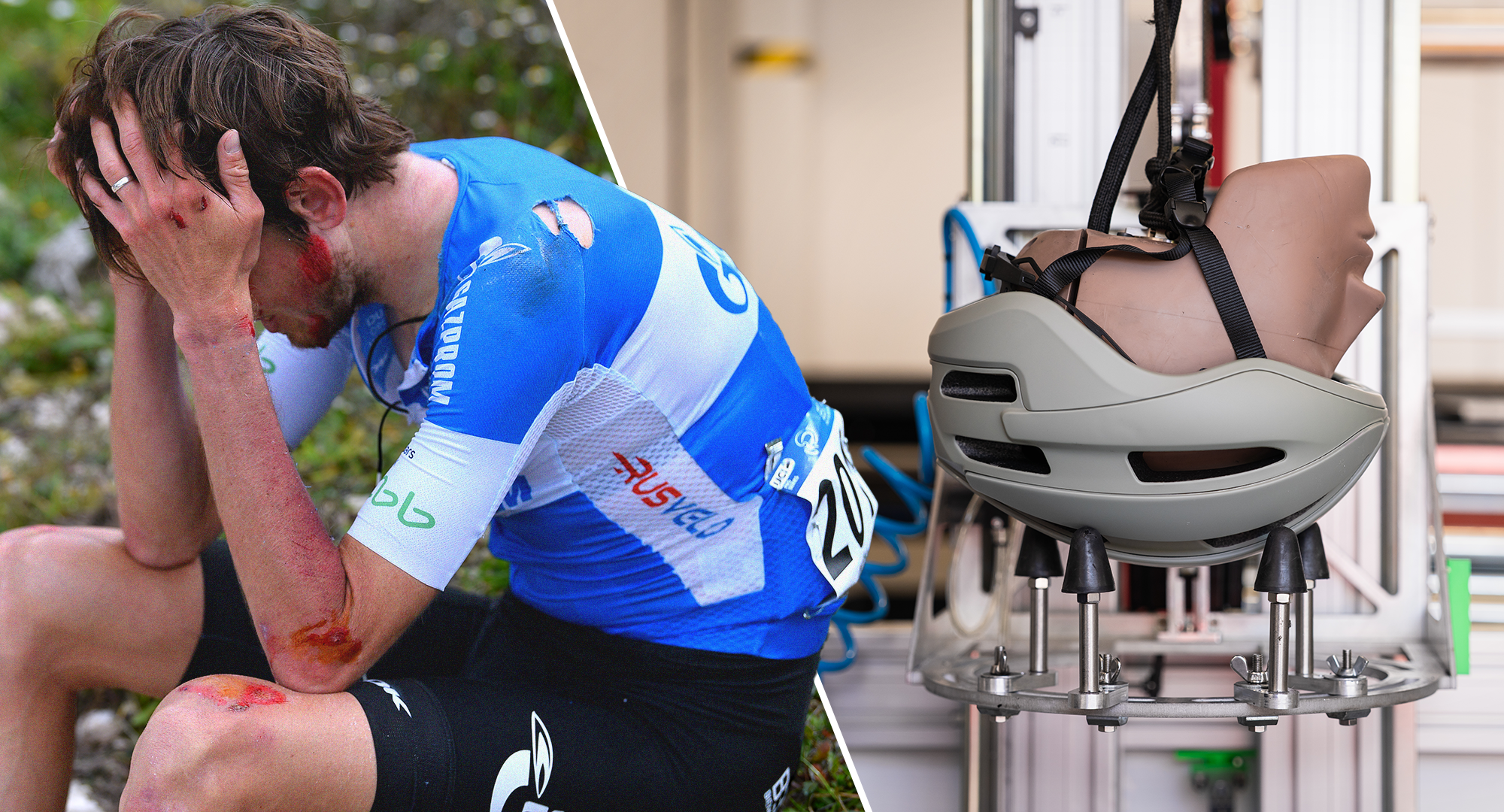
Helmet safety awareness and the danger of head injuries from cycling crashes is growing, so why haven’t helmet standards changed for years, and what is being done to improve the technology that protects our brains as cyclists?
Studies show that rotational impacts are a major cause of traumatic brain injury (TBI) but currently no cycling helmet sold in the UK and Europe is required to pass a rotational impact test.
A test for how helmets deal with rotational head impacts was created and published in 2024, but two years on, the committee tasked with setting a pass mark is yet to agree whether, or how, to require it, and so many helmets are missing a key standard of safety and protection.
Mips (multi-directional impact protection system) technology has long been the market leader in rotational impact technology, and you’ll see its yellow sticker and protective system on many helmets. Mips technology is fitted between the inner padding and outer shell of the helmet, and allows for slippage and movement that helps reduce the rotational impact transferred to the wearer’s head.
-
sale
Topeak Rocket Micro CB Mini Hand Pump
Rated 5.00 out of 5£44.99Original price was: £44.99.£35.99Current price is: £35.99.

Whilst popular, Mips is not the be-all and end-all of helmet safety technology, and new externally-fitted solutions like RLS have come into play in recent years, but the helmet industry – and riders – are still waiting on a universal standard.
We spoke to leading figures from helmet technology manufacturers, helmet brands and independent testing bodies to find out what is standing between the industry and a better safety standard, and what the future of helmet safety might look like.
Why rotational impact testing matters
Cycling helmets sold in Europe are certified to European Standard EN 1078, which was last updated in 2012, nearly a decade and a half ago. It tests only linear, straight-on impacts.
A 2023 study by Imperial College London found that most real-world cycling brain injuries are caused by rotational forces from the head hitting the ground at an angle, rather than straight on.
This is noteworthy because when the head hits the ground at an angle, it twists, and the brain is stretched and sheared because of this rotation. This can damage the nerve fibres that carry signals around the brain, as well as blood vessels, resulting in concussion or more severe damage such as a TBI.
This is why many believe in the importance of testing cycling helmets at angled or oblique impacts, as this is more representative of real-world bike collisions – and indeed rotational impact is often more dangerous and more severe than a straight-on knock.
Innovating external solutions
Despite the lack of a European Standard or wider requirements for helmets to also protect against rotational impacts, plenty of manufacturers, scientists, and innovators are working to create systems that better protect riders and get this technology into more helmets.
The Release Layer System (RLS) is a newer rotational impact technology which works by having panels bonded to the outside layer of the helmet which move on polycarbonate bearings. Upon impact, these panels absorb energy and release from the helmet, reducing the amount of rotational energy transferred to the rider’s head.
I was invited to see this technology firsthand at the RLS facility in London, complete with a testing drop tower they use to assess the impact helmets absorb.
RLS says its technology lowers the risk of a brain injury like concussion from 64% to 9% when compared to a standard road helmet.
“Because the technology is on the outside, the moment you make an impact, the technology is able to instantaneously work rather than being in those microseconds absorbed and then having to do the work on the inside,” explains James Cook, CEO of RLS.
“When you increase the energy, a lot of solutions don’t work very well because there’s too much pressure. That’s where actually a bearing solution is really good because bearings have been used for high pressure.”
Cook adds that the panels are designed to survive everyday knocks and will only come apart under a significant impact.
RLS grew out of HEXR, a helmet brand Cook co-founded, which it now uses to test the technology.
Internal vs external
While Mips has long dominated the market with its internal slip layer system, there is a consensus that external solutions like RLS could also work well, or even better.
“Reducing friction on the outside is a better idea than reducing it on the inside,” says Alessandro Cernicchi, R&D director at helmet manufacturer Kask.
“If you want to redirect energy, a good way to do that is on the outside of the helmet because you have quite a big surface there and you can create a big movement and so on,” says Max Strandwitz, CEO of Mips.
Mips developed its own external concept in 2017 called Impact Shield. However, Strandwitz believes that external solutions can be too sensitive.
“We were a little bit reluctant to release the Impact Shield because as soon as you have solutions on the outside of the helmet, they become very sensitive. If you drop it or if you bump into something, all of a sudden, the technology is out.”
Despite his hesitations, Strandwitz says Mips might reconsider an external solution.
For now, Mips’ market position remains formidable. He says Mips is adding its technology to almost one new helmet every working day across all categories, including snow, motorcycle and industrial helmets, with cycling making up roughly two-thirds of its business.
The power of the yellow dot sticker is reflected in Fizik’s decision to enter the helmet market with Mips.
“Being new into a category, we haven’t got years of people telling good stories about our helmets, and we knew what a well-respected brand name could do in terms of entering a new market,” says George Huxford, senior marketing manager at Fizik.
The elusive mandatory test
There are two main European Committee for Standardisation (CEN) working groups related to implementing a rotational impact standard for helmets.
Working Group 11 (WG11) set a rotational test method called EN 17950, with a new headform – the dummy used for testing – which was published in 2024. This headform is regarded as more representative of a human head. It took over 10 years for the group to agree on this, and even now there are some disagreements.
Working Group 4 is revising EN 1078, the standard to which every cycling helmet sold in Europe is certified and may establish a pass/fail mark for helmets with regard to rotational impact. It is this revision which would mandate that all helmets be rotationally tested as per EN 17950 and the headform which should be used in testing.
The working groups are made up of manufacturers, brands, ingredient technology companies, universities, test labs, governments and consumer groups, all of whom will be impacted by what is agreed, which may be having a disproportionate effect on the decisions these groups are or aren’t taking.
“It’s really a shame that standards have not yet adopted rotation, and I think it is the elephant in the room,” says Professor Mazdak Ghajari of Imperial College London, who co-authored WG11’s research on the new headform.
“Well, I may upset some of my colleagues on the working groups, but the truth is that over 80% [of parties sitting on the committees] are manufacturers,” he adds. “They are members of the committee for good reasons; we cannot set a standard that they cannot meet or which costs them a massive amount of money.
“But at the same time, they told me that they spent 80% of their budget and R&D on optimising products for the current standard. Now imagine if there is something new, then they have to inject new money into understanding how their product would perform so obviously there is a lot of inertia.”
“There is a lot of politics which I think doesn’t belong in the regulatory body for safety standards,” adds Strandwitz, also noting the difference between the US and European approaches.
“In [the] US, it’s a much hotter potato, and they are moving and will probably move a lot quicker,” he says. “In Europe, you are still having some that are a bit conservative, and that think rotation is not a big problem.
“My experience is that it’s seriously conflicted,” echoes Cook, who sat on WG11. “People are not just thinking about how they protect people; they’re also thinking about how they protect the business.
“There’s a deadline that the European Commission sets, but then there are ways in which the working groups can collectively not align to either extend the timeline or push things back, and that’s effectively what’s going on. It’s just the can is being kicked down the road again, and again, and again, and I’d say it’s costing people’s lives.
“We’re seriously keen to try and push to have at least a standard that recognises rotation, but then also push to have a pass/fail criteria that means that more helmets are going to be safer on the road.”
However, Cernicchi at Kask views conflict within the group as expected and healthy, since all stakeholders are represented.
Kask developed its own in-house rotational test, which it even calls ‘WG11’ and was criticised at the time for borrowing the working group’s name, adding to some frustrations within the group.
Cernicchi believes a cautious approach is best.
“It’s kind of a revolution in the way we are testing helmets; we’ve been testing helmets for years with linear impact, and now we are proposing to introduce rotation. You want to do it very, very carefully.”
Test limitations
The headform, the dummy used in testing, is meant to reflect a human head and was a major sticking point for WG11 members to agree on. Headforms have different coefficients of friction from one another and thus produce different results.
Kask still uses the EN 960 headform in its testing but says it plans to transition to EN 17950 headforms from 2027.
“The EN 17950 standard is still not perfect, so we still have to work on it to make it perfect, and then we can start adopting rotational methods for certifying helmets according to the product standards,” says Cernicchi.
He says EN 17950 headforms made by different manufacturers produced results up to about 10% different, and experts want that narrowed before rotation can go into EN 1078.
“We have to rewrite it to have narrower tolerances before we can introduce [the] rotational method in the 1078 and all the other product standards.”
Any new headform also comes at a cost to manufacturers, which could also be a factor behind the slow implementation of more accurate headforms.
“If Europe agrees to approve a new headform, it will mean an investment of somewhere around €20,000 to €25,000 for a lot of companies because you need to invest in a new headform,” says Strandwitz.
“This should have been done already a long time ago. If you look at the EN 960 headform, it’s 30 years old, and it’s not biofidelic. It’s a magnesium headform without the nose, and it looks extremely flat.”
Independent ratings and testing
There’s another layer of complexity around helmet testing and standards, and that’s who pays for the testing and research.
Brands often test their own technology in-house. Kask, for example, has its own testing protocol, WG11, and now has its own in-house testing laboratory. RLS has its own drop tower and publishes side-by-side test videos, while Strandwitz says Mips runs 15,000 to 18,000 tests a year but doesn’t publish them publicly.
Strandwitz doesn’t think that brands publishing their own test results is enough, and retains some scepticism about the results we do see.
“For me, it will be strange if you, as the market leader, say: ‘Look what we have done at home!’ Who would publish a test that doesn’t come out well?” he says. “If you have a technology that is good enough, you can rely on third-party testing, and that’s what we do.”
Professor Ghajari launched Hiper two years ago as an independent safety rating system, developed by researchers at Imperial College London and funded by The Road Safety Trust.
Hiper buys each one of the helmets it tests and does not accept money from brands, which Ghajari says helps maintain independence.
“It’s very important because even manufacturers tell me that they can send a helmet to rating that is different to the helmet they send to the market,” he says. “It is a known fact and another elephant in the room.”
Ghajari adds that Hiper’s ratings are meant to sit alongside the standard as they provide consumers with safety information beyond the minimum, which is important as a high price point does not equate to a safer helmet.
The latest Hiper ratings looked at collapsible and normal helmets and found that a higher price does not mean greater safety.
The highest-rated helmet in the gold category was the MET Vinci Mips, which costs £100, while the Van Rysel RoadR 500, which costs £29.99, was awarded silver, and a £95 collapsible Overade PLIXI came last in the bronze category.
Hiper has not yet rated a helmet that uses RLS.
An Imperial College study, published alongside the ratings, also highlighted the importance of rotational impact solutions, as “the presence of rotational protection technology significantly reduced both linear and rotational injury risk in helmets”.
Using the new EN 17950 biofidelic headform, Ghajari says Hiper’s test repeats each impact on three samples for statistical distribution, adding that he believes Hiper’s testing method is more rigorous than that used by other leading helmet testing body, the Virginia Tech Helmet Lab.
Virginia Tech uses a NOCSAE headform, and each helmet rating is based on 24 oblique impact tests across six locations and two impact speeds. The laboratory tests helmets across all kinds of sports and activities, including hockey, baseball and American football, as well as construction, horse riding, and, of course, cycling.
“Our published research also shows that the NOCSAE headform’s vibrational response aligns more closely with published human-head measurements than other headforms,” says Steve Rowson, professor at Virginia Tech and director of the Virginia Tech Helmet Lab.
“Hiper’s published methodology also incorporates both linear and rotational injury measures, although its calculation differs from ours. Our methods are publicly available and published in peer-reviewed journals, and manufacturers do not influence the rating methodology or the assignment of ratings.
“We purchase helmets for our ratings. We also sometimes test helmets before their public release so manufacturers can have a rating available when the product reaches consumers. In those cases, the manufacturer must provide written certification that the submitted helmet is identical to the product consumers will be able to purchase.
He adds that sometimes they conduct random follow-up testing to ensure that a submitted sample is identical to the retail product.
In Virginia Tech’s bike helmet ratings, RLS has two helmets with its technology in second and third place overall, while helmets with Mips start at seventh place.
Strandwitz argues that Virginia Tech’s current testing is slightly weighted towards external solutions.
“The challenge is that in a straight impact, these solutions normally perform quite well. In Virginia Tech, for instance, that impact point is weighted much higher than anything else, but you need to manage impacts in all directions.”
Rowson disagrees with that notion, however.
“Our scoring system does not include any variable for the presence, brand, supplier, or location of a particular technology,” he underlines. “We evaluate the complete helmet under the same published impact conditions, and its score depends on the measured head response. Manufacturers can improve that response through materials, geometry, integrated features, or additional components.”
There are other questions around independence and commercial interests in the world of helmet safety, partly due to the fact that it’s a small niche and funding and personnel overlap a lot.
For example, the main peer-reviewed study of RLS, published in the ASME Journal of Biomechanical Engineering, was funded by HEXR, the helmet brand founded by Cook, and some of its authors are affiliated with HEXR and RLS.
RLS states that testing was conducted independently at the iCUBE laboratory of the University of Strasbourg and the RLS laboratory in London, and results are validated externally and peer-reviewed.
Should the UCI step in?
Whilst helmet safety technology applies to every cyclist who uses a helmet, whether that’s for a short commute or a professional race, there is an added layer of urgency, concern and danger when it comes to pro riders who are racing at higher speeds and face more frequent and larger crashes.
The UCI instigated a concussion protocol and has various rules about what equipment pro riders can and cannot use, but it does not mandate rotational impact testing or ingredient technology for helmets used in road racing.
Cook at RLS says they’ve been talking to UCI for about two years. He points to the speeds at which pro riders compete, which he thinks should encourage the UCI to mandate a testing standard.
“It sounds like UCI are thinking about it in the right way, and they know it’s on their roadmap, but we also don’t want to let it stall,” he says.
“We’re here to support the UCI; we’re here to support anybody in terms of trying to create a standard that actually protects people, but we also want to make sure that if it’s going too slowly, we can nudge it along by sharing data and being quite open about it.
“Given that we already know there are lots of people dying every year, let alone having concussions, I would have thought someone at the UCI would be spearheading this.”
The UCI responded: “As the process and discussions are still ongoing, the UCI will not comment on this topic. We will communicate once we have more information and details.”
What the future could like
In motorcycling, there is already a rotational impact test standard, ECE 22.06, which some believe cycling should mirror.
“Get something going and then improve from there,” is Strandwitz’s hope for the immediate future of helmet safety technology. “In motorcycling, with ECE 22.06, they at least did it, even with the old headform.
“When you do that, you can filter out the worst-performing helmets on the market, the helmets that should never be there.”
“The motorcycling federation has also gone above and beyond what the European standard is,” adds Cook. “They’ve said we want to see helmets that meet an even higher performance.”
However, Cernicchi disagrees, remarking that he’s never seen a helmet fail the motorcycle standard, which suggests the bar is set too low.
So, what are we left with?
Any certified helmet is clearly better than none, but with experts who set the standard still disagreeing, it looks like rotation will remain the ‘elephant in the room’ for a while longer.