“It was the season of Light, it was the season of Darkness, it was the spring of hope, it was the winter of despair, we had everything before us, we had nothing before us.” – A Tale of Two Cities
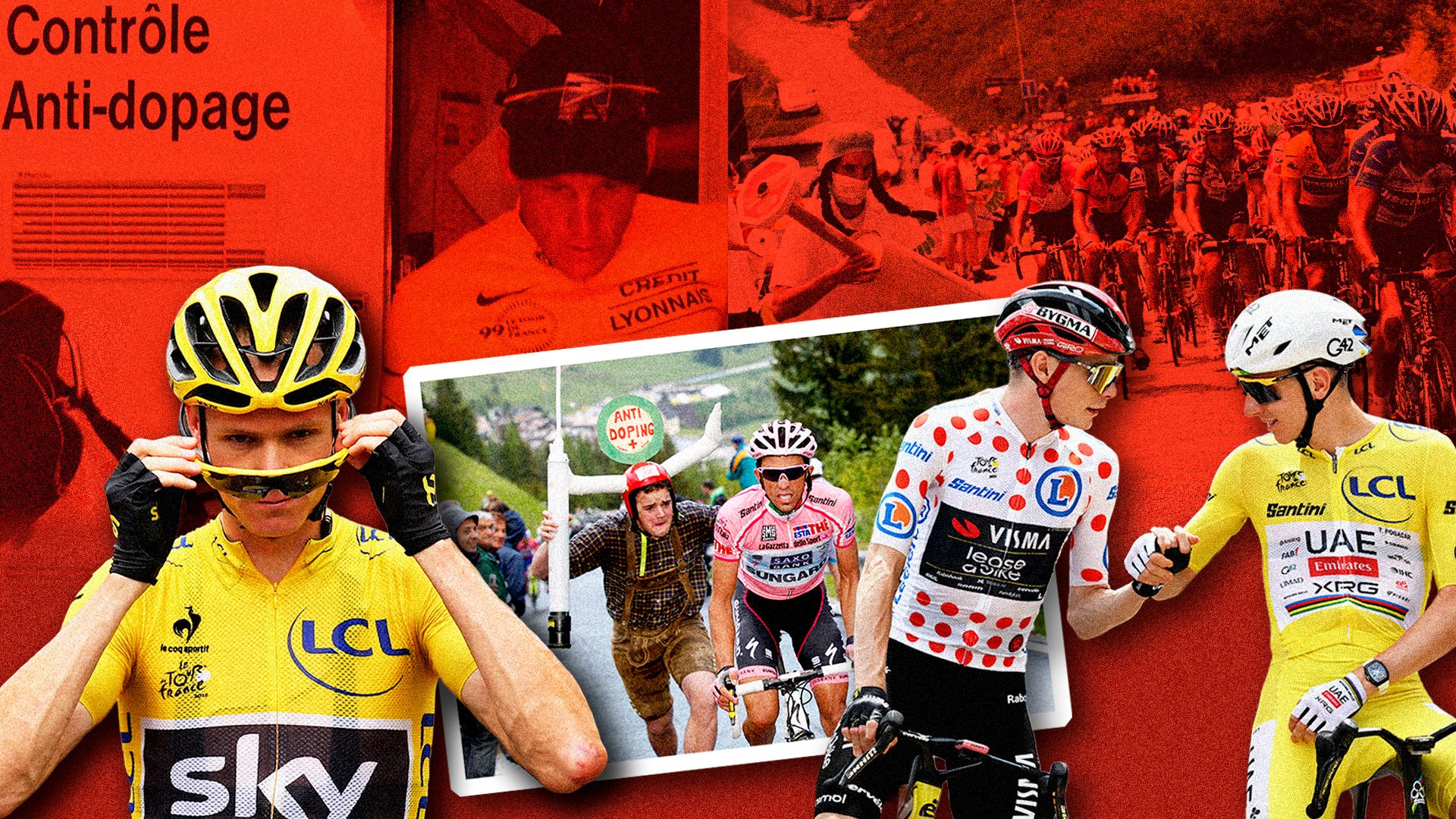
Chris Froome was coming off a career high. His stage win on Mont Ventoux had laid the way for a first Tour de France victory in 2013.
The problem was that his emphatic performance coincided with an all-time low in trust in pro cycling; scandal after scandal, lie after lie, burned its followers.
The next morning, a hundred members of the media crammed into a conference room at the Park Inn Hotel in Orange to bury the yellow jersey with demanding questions, not to praise him.
-
sale
Trek Dual Sport 3 Gen 5 2025 – Hybrid Sports Bike
£975.00Original price was: £975.00.£899.00Current price is: £899.00.

The bombardment began: “What plan do you have to answer the critics suggesting doping may be behind his performance?”
“Yesterday you said you were ‘honoured’ by the comparison with Lance Armstrong. How can you be honoured given he got all his titles with doping?”
Sat next to him, Team Sky principal Dave Brailsford was also in the crosshairs.
“Dave, can you provide me with your most compelling reason why we should believe not just Chris but every single member of your team?”
The kicker at the end to the race leader: “Is all this beginning to tarnish the whole experience for you?”
“I just think it’s quite sad that we’re sitting here the day after the biggest victory of my life, quite a historic win, talking about doping,” Froome said. “Quite frankly, my teammates and I have slept on volcanoes to get ready for this, been away for months working our arses off to get here. And here I am basically being accused of being a cheat and a liar. And that’s not cool.”
With that, the mild-mannered Briton got up and strode out of the room. That spicy 15-minute press conference was a memorable indictment of the crippling lack of belief in the sport.
How could we not talk about doping? The Festina Affair in 1998, Operation Puerto and the Floyd Landis testosterone Tour in 2006, Michael Rasmussen’s dramatic departure from the race twelve months later, Alberto Contador’s drawn-out clenbuterol ban in 2010, then, perhaps most egregiously, the fall of Lance Armstrong and the USADA Reasoned Decision in late 2012.
There was the same cycle after every scandal: talk of rebirth, springs of hope leading to more controversy and winters of despair. Being a cycling fan, let alone a journalist, who believed wholeheartedly in what they were seeing play out on the road was like outing yourself as someone who also thought the Tooth Fairy, Father Christmas and flying pigs existed.
Back then, the sport seemed irredeemably rotten. Every record-breaking ascent raised eyebrows; many superhuman performances were treated as guilty until proven clean, with the baseline assumption that most racers were on something. Doping talk – pharmaceutical and mechanical – was a constant background thrum, asked about in every long-form interview. And if I had a pound for every time I heard or read the going-through-the-motions answer from a bike racer: “the sport is much cleaner now…”
At the pinnacle of performance, Team Sky, Froome and company preached pristine values and zero tolerance to a crowd of angry non-believers. No wonder it occasionally got ugly.
At times, the racing was like a sideshow to the volatile atmosphere between the peloton, spectators and media. Riders felt the frustration and distrust, sometimes physically: Froome had urine thrown at him, was slapped and spat at, super-domestique Richie Porte was punched, and the Sky team car was battered and rocked by spectators on Alpe d’Huez.
Fast forward a decade and it feels like a wholly different discourse. The way races are taken on has changed, and so has the paradigm. There is a lot less adversarial feeling: the worst ‘bad blood’ Tadej Pogačar has experienced is scattered boos on a few Tour de France stages or, bizarrely, getting crisps thrown in his face.
Yet the peloton is going faster, breaking climbing records from the bad old EPO days. Seven watts per kilo appears to be the new frontier for stage-ending Grand Tour climbs. Rather than police raids on team hotels or a positive test revealed on a rest day, as used to be habitual, the Tour de France’s big doping story this summer surrounded nighttime testing. Some observers expressed outrage at waking up Pogačar and Jonas Vingegaard in the middle of the night before a key Alpine stage.
The sport is moving from being mired in doubt and traumatised scepticism to a more protective level of fandom – and one of the reasons for that has little to do with pro cycling.
Social media and our parasocial relationship with the sport’s stars
Not so long ago, a rider’s primary means of self-expression was limited to interviews with online cycling media or magazines, perhaps a brief appearance on Eurosport. A comparatively limited output, a slow-burn way of getting to know them.
The digital media landscape has transformed. Social media and video-sharing platforms allow an infinite scroll of unfettered, unfiltered-appearing access, leading to a closer, more parasocial relationship with the sport’s protagonists.
Consequently, traditional print media is no longer the primary storyteller; control of the message has shifted to top riders, squads and brands. Short-form video is king, whether that’s from racers like Victor Campenaerts vlogging authentically pre-race on Instagram or sizable in-house media teams posting curated content for YouTube and other platforms.
With all the proximity over the months and years, a passive, subconscious background swell of positive feeling washes over some followers, driven by personality and good vibes. Doping never comes up organically in their narratives; why on earth would it? Positivity sells – they want your love, but don’t forget that in a sport bankrolled by businesses, the sponsors or partner cycling brands also want your money – not thorny stories lacking in digestibility.
That shift means the d-word is more likely to be further out of sight and mind, alongside the fact that it has been almost ten years since a seismic cycling scandal. It is easier than ever for doping, the sport’s number one enemy in the 21st century, to slide into the collective mental background.
The sport appears cleaner too. Empirically, there has been a fall in the number of positive doping tests, going from 29 in 2022 to 20 last year. It is over a decade since a rider was thrown off the Tour de France – Luca Paolini, for a cocaine positive in 2015.
Of course, most cycling fans are not naive. They know an apparent lull does not mean doping is a vanquished scourge. After all, it’s only been three weeks since Alberto Bruttomesso (Bahrain Victorious) was suspended for anti-doping rule violations.
But it takes a big champion to get caught in the net to register with a whole community, and that last happened in 2017, when Chris Froome registered an Adverse Analytical Finding for salbutamol, ultimately being cleared of wrongdoing.
Some modern sport fans’ battlegrounds have also moved from doping doubt onto personality, beliefs or politics. In the polarised world of social media, where opinions fly around as freely as leaves in an autumn gale, I see both greater warmth and protectiveness towards some racers and a more deeply reinforced negativity against others.
Take Lidl-Trek rider Quinn Simmons, who told me in December 2025 for Cyclist that certain people have “harassed” him his whole career, but that for every negative comment, he gets ten positive ones. Real life is very different to the online world’s vocal, invisible minority: the American champion turned up to a 2026 Tour de France stage start in the town of Aurillac (i.e. the middle of nowhere) and encountered a French fan who had driven six hours to be there, wearing his team kit and impressively recreating his hair, beard and moustache combo.
Can Pogačar and today’s peloton make reparations for previous errors?
Figurehead riders or squads tend to set the tone of every era, and Team Sky came to embody a lot of the previous era’s ills, as well as bringing a few of their own. Sharing Chris Froome’s 2013 Tour power data with French newspaper L’Equipe – an act which is seemingly more than any leading contemporary team has done – did not quieten the questioning voices. The issue put forward remains the same as now: how do you prove a negative?
Ultimately, the zero tolerance team did not break the toxic cycle or cleanse themselves of the whiff of wrongdoing. In 2018, a British parliamentary committee found that the team “crossed an ethical line” over the use of medical exemptions for banned drugs, related to the jiffy bag farrago.
The drift away from traumatised scepticism has probably been helped by the changing of the guard: Sky is no longer the sponsor, and current incarnation Netcompany Ineos does not rule the roost.
After the transition of cycling power, new bosses UAE Team Emirates-XRG are not so different on the face of things. The probable richest team in the sport, winning Grand Tours repeatedly with a coterie of well-paid helpers, most of whom could be leaders in their own right – check, check and check again, straight from the “Death Star” playbook.
Associations with doping? They have a few. Mauro Gianetti and Matxin Fernández were managers of Saunier Duval, the team embroiled in doping scandals at the 2008 Tour de France. Kristijan Durasek was suspended after being named in Operation Aderlass in 2019, and rider Marc Soler’s father Jaume received a (now overturned) suspension in February 2026 for working with banned ex-US Postal doctor Pepe Martí (there is no suggestion of wrongdoing by Marc Soler himself). Some fans may also look negatively upon the team’s close association with the United Arab Emirates, a Middle East oil giant with a “dismal” human rights record, according to Amnesty International.
But none of this mud sticks, and that has much to do with the individual who defines this decade in pro cycling. Tadej Pogačar holds a lot of soft power, not just as an exemplar of spectacle and excellence, but as a transmitter of sympathetic feeling and good vibes to his team and the sport as a whole from his own actions and image.
To paraphrase Mads Pedersen, if the modern peloton feels like repairmen for their predecessors’ wrongdoings, Pogačar is the inadvertent head fixer in this move from embattled past to a present of fragile hope.
Though he has not faced the Spanish Inquisition level of questioning that Team Sky and its leaders encountered, Pogačar has quickly learned to answer challenging questions better than “I’ve never tested positive”, his 2021 groan-worthy echo of a Lance Armstrong answer.
He has faced down queries about doping, his credibility and UAE’s connections to the sport, never flying off the handle or pouring fuel on the fire like more combative superstars of recent generations. He understands that such inquiries are the lot of every new world-beater in this day and age “because cycling was so damaged in the past, before my time”.
Generations change, but professional sport doesn’t. Those seeking optimal performance will still use any legal method – such as carbon monoxide rebreathing, grubby but lawful – and some will inevitably go over the ethical and permissible line. Anti-doping agencies are historically under-funded and invariably playing catch-up against the next doping advances. It takes a long time for a culture to alter and, as a product of my time, scepticism is baked into me.
But I think some cycling fans have moved on, allowing themselves to be more cautiously hopeful – to believe again. That’s something to be cheerful about, with a caveat: after a good while without a sport-shaking controversy, the shock and damage will likely be even greater if an epochal racer is caught in the net. We aren’t out of the woods yet, just in a clearing.